The Missing Front Door: How Hong Kong’s Healthcare Gap Continues to Fuel Rising Costs

They said no one would text a doctor.
They said the same about banking on a phone or ordering food delivery. Now we do both without thinking, and we barely remember the scepticism that surrounded them.
Yet in Hong Kong, when it comes to healthcare, that scepticism is still alive and well. There is the conventional wisdom: people prefer face-to-face in person care, private clinics are accessible, and there is little appetite for virtual care. Why fix what is not broken?
But as a Hong Kong Permanent Resident, and a seasoned veteran of the insurance industry, I would argue that the private healthcare system is broken in one very specific way. It lacks an efficient front door and relies too heavily on the “consumer knows best” mentality. Let’s discuss.
The Gap That Is Costing Everyone
It is widely publicised that Hong Kong has the second highest private healthcare costs in the world, and medical inflation is running at 8–10% annually (Henley & Partners, 2025).
Care doesn’t typically follow a layered structure of triage before escalation. Usually, patients are not guided to the right level of care or seeing the right specialised providers only if still needed - thus, there is limited control of higher costs.
The most effective virtual care models should be more efficient. And, luckily, there is a framework available that can remedy these shortcomings.
The ideal virtual state
In an efficient model, users start with intelligent navigation - an AI-led “front door” that helps them describe their needs, without relying on the user to exercise any judgement as to who they need to seek care from. Then, this system uses adaptive learning to direct them to the appropriate next step: escalation or resolution.
After the initial navigation, if a consultation is needed, users can be routed to a more comfortable method of care: asynchronous, message-based care - where users can ask a question and receive a response from a doctor without needing to be online at the same time. When necessary, these text cases can be escalated to almost instant synchronous video consultations (i.e. real-time interactions such as video or phone) only when additional care is required.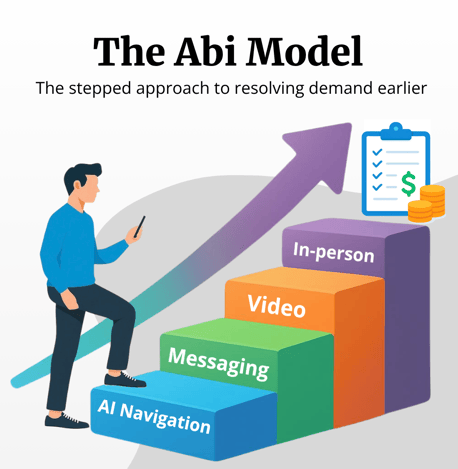
This stepped approach (which I will call “The Abi model”), where messaging comes first, not only makes things convenient for the user. It matches need to the right level of care - resolving more demand early, and preventing unnecessary escalation into high-cost settings. It also creates a point of influence before unnecessary claims, leakage, or escalation occur.
However, without these efficiencies (“front door” navigation, messaging-based care, and on-demand virtual care), patients with minor concerns either delay seeking care until their symptoms become severe or funnel directly into in-person care - both of which drive up unnecessary cost.
The point of influence comes before the claim
Perhaps another pressing issue is that traditional claims controls are broadly reactive. Pre-authorisation, panel management, and reimbursement checks all happen after care has already begun. But the real point of influence comes earlier. It comes the moment a member first asks, “Should I see a doctor, and where do I go?”
And if you are thinking there are already insurer panels for this, you’d be right. They are designed to control quality, manage cost and reduce fraud, waste, and abuse. However, static provider directories assume members already know what care they need - when the reality is that most members do not know where to go at all.
This is why an AI-powered navigation layer, like Abi’s, matters. It meets people at the start of their health journey, helps them explain what they need in their own words, and uses the ideal model we talked about earlier to route them - whether that is to self-care and education, a virtual healthcare professional, or escalation to an in-network service only when that pathway is required.
Health journeys do not start with doctors - they start with questions. The organisation that is present at that moment shapes the cost and outcome, while the organization that is absent absorbs the consequence later.
The Cultural Objection – And Why It Is Overstated
Efficiencies and change (in general) are not without some objection, so allow me to acknowledge and address the most common one. It’s the idea that people in Hong Kong prefer to see a doctor in person.
While this concern is valid, the data suggests the opposite. A 2023 territory-wide survey found that 51.6% of residents are willing to use teleconsultation in primary care, and among those who have used it, 95% report finding it useful (Telemedicine and e-Health, 2024).
The truth is that the Hong Kong Consumer Council points to fragmented access, unclear insurance coverage, and the absence of clear consumer-facing entry points as reasons people inconsistently use an effective digital alternative. The complications push them toward using traditional methods of in-persion care - not because they are better, but because they are a clearer pathway (Hong Kong Business, 2024).
The barrier is not cultural. A lack of consistent, simple structure into care and no clear entry points to access hold back virtual care use. There is no need to change behavior through persuasion. People change when a better, easier option naturally fits into their daily lives.
The behavioral science argument
And speaking of behavior, let’s look a bit at some numbers. According to a Harvard study, roughly 70–80% of people already search their symptoms online before seeing a doctor. This tells us that the behavior already exists. But there’s more to this.
Expectations are shifting: 80% of healthcare consumers want to use digital messaging tools, and 83% say this influences their choice of provider (Harvard Medical School, 2024). Furthermore, 88% of Abi users globally choose messaging over video or voice. How can this be possible when we think people are hesitant to change? We can look at other digitally adapted industries for the answer.
Just look at banking, food delivery, or customer support. We once doubted people would trust an app with their money, rely on a Deliveroo driver for dinner, or help us find a life partner. Today, these are defaults because they are convenient. The parallel for healthcare is direct: If we trust an app with our money and our food, the barrier to asking a local doctor a health question via message is much lower than we assume.
However, a static symptom checker is not enough - neither is a generic appointment-based telemedicine flow. Members need a model that provides immediate guidance and a clear route to access care. Starting from a simple user question,the Abi model is fundamentally different - it removes friction, the real barrier to adoption.
The lift-time test
I’ll illustrate the difference, starting with a local example. In Hong Kong, life happens in small windows - waiting for the lift, standing on the MTR, moving between meetings. In the time it takes for a lift to arrive, an Abi user could have already sent a message and begun their consultation with a qualified local healthcare professional.
This is where the Abi model excels while traditional telemedicine falls short. 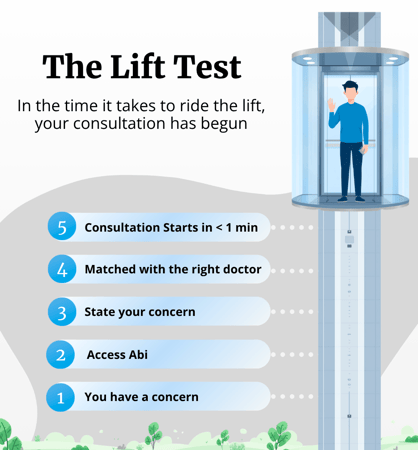
Appointment-based models and queuing systems not only create higher cost for the payer, they create the same friction as physical care. I need to pick the right doctor, book an appointment, wait… And all for questions that often sit in a grey area: “Do I even need to see a doctor?”
That is exactly why asynchronous, on-demand virtual care fits so naturally here. With the right model, care fits seamlessly into fast-paced Hong Kong life.
Health concerns do not follow clinic hours
When we talk about convenience changing behavior, it’s important to understand what that convenience actually means. Aside from intercepting demand and reducing unnecessary escalation, virtual care should be available 24 hours a day - even outside of traditional clinic hours.
Our data shows that 22% of consultations globally occur out of hours, rising to 31% in Asia. Without an always-available channel, those moments either escalate to higher-cost emergency care or go unaddressed. But with the Abi model, even out-of-hours, it’s easy to connect to a doctor in literal seconds - via text or video. And this in turn, drives engagement.
But all Abi services (whether asynchronous or synchronous) are delivered without the need for an appointment, and at a cost that remains more efficient than traditional virtual consultation models, despite the higher engagement. Let’s explore how this is possible below.
Why the Model Matters
To state this clearly: higher engagement does not mean higher cost. When the model is designed correctly, the opposite is true.
Abi’s stepped approach resolves demand earlier and routes users to the most appropriate level of care from the outset. Starting with low-cost, AI-powered navigation and escalating only when clinically required, more cases are resolved at the earliest stage - preventing unnecessary progression into higher-cost services.
This is proven in practice. 81% of Abi consultations are resolved with no further medical intervention, avoiding in-person care entirely, and delivering measurable reductions in overall service delivery cost.
Across real-world deployments, this translates into higher engagement, reduced reliance on high-cost channels, and a more efficient, sustainable model of care.
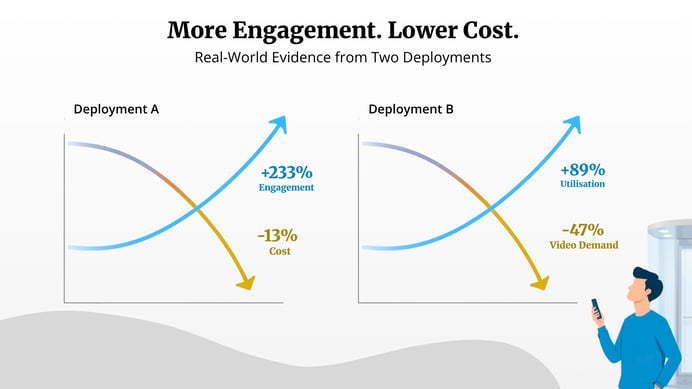
For insurers and ecosystem partners, this is the critical point. Cost savings does not come from restricting access. It comes from directing demand properly the first time. When the model works well, more people engage, but fewer require high-cost care.
The Case for Acting Now
The private sector here is accessible, perhaps too accessible. However, easy access without guidance drives over-utilisation, unnecessary investigations, and avoidable referrals.
This is particularly acute because Hong Kong's private healthcare market operates on a largely fee-for-service model. When insured patients enter the system, providers know the costs are covered, which significantly amplifies the structural incentive to over investigate, prescribe, and refer.
It’s not a marginal issue. Healthcare fraud, waste and abuse is estimated to account for 3–15% of total global healthcare expenditure (Archives of Public Health, 2025).
This is the real consequence of a missing front door. It is not simply that digital options are absent. It is that the system loses its ability to guide, steer, and resolve demand at the lowest appropriate cost point.
Medical expenses in Hong Kong have already risen by 9.9% over the past decade, and costs across the Asia-Pacific region are projected to increase by over 14% in 2025 (WTW, 2024). For insurers, plan sponsors, and ultimately members, this trajectory is unsustainable without intervention.
The question for Hong Kong is not whether the model works. The evidence is already clear across markets, Abi deployments, and user behavior.
Instead, the question is actually whether Hong Kong will embrace these missing layers before rising costs force a more reactive response. And whether Hong Kong will add the missing “front door” to make what is unfamiliar today expected tomorrow.
Abi is already working with insurers and health ecosystem partners to deliver this model in practice.
Learn more about Abi’s Navigator and virtual care capabilities: hello@abi.ai.
About Abi
Abi Global Health is a pioneer in next-generation virtual care, delivering on-demand access to healthcare professionals empowered by AI.
Founded in 2016, Abi enables users to connect with licensed doctors, nurses, and specialists in seconds, embedded into existing digital interfaces such as chat apps, websites, and mobile platforms.
Operating across more than 40 countries and 25 languages, Abi provides 24/7 access to trusted healthcare professionals worldwide. Abi partners with insurers, governments, and digital health innovators to embed scalable virtual care directly into existing digital ecosystems.
By combining AI-driven triage, intelligent provider matching, and omni-channel consultations, Abi helps organizations expand healthcare access while improving efficiency and reducing costs.
Today, Abi services are accessible to more than 12 million people globally, helping transform how healthcare is delivered.
References
Archives of Public Health (2025). A global scoping review on the patterns of medical fraud and abuse. https://pmc.ncbi.nlm.nih.gov/articles/PMC11831774/
Government of Hong Kong (2025). The government announces measures related to healthcare workforce and regulation. https://www.info.gov.hk/gia/general/202503/26/P2025032600440.htm
Harvard Medical School (2024). Digital health content meets people where they are. https://learn.hms.harvard.edu/insights/all-insights/digital-health-content-meets-people-where-they-are
Henley & Partners (2026). Henley Global Mobility Report 2026: Ranking private healthcare costs globally mobile. https://www.henleyglobal.com/publications/global-mobility-report/2026-january/ranking-private-healthcare-costs-globally-mobile
Hong Kong Business (2024). Consumer Council advocates 5 recommendations to improve telehealth services in Hong Kong. https://hongkongbusiness.hk/news/consumer-council-advocates-5-recommendations-improve-telehealth-services-in-hong-kong
Telemedicine and e-Health (2024). [Study on teleconsultation use in primary care]. https://pubmed.ncbi.nlm.nih.gov/39545278/
WTW (2024). Asia Pacific expects high medical inflation in 2025. https://www.wtwco.com/en-vn/insights/2024/12/asia-pacific-expects-high-medical-inflation-in-2025